
Painting, staining, sealing & coating are four different jobs
Most homeowners say they want their pool deck painted. That's a fair way to describe the goal: a clean, even color on a deck that looks tired. But the four products people mean by it behave very differently on concrete that sits wet half the year and bakes in Northeast Florida sun the other half.
- Deck paint. An acrylic film rolled on top of the concrete. Fresh color fast, cheap to buy — and the first thing to chalk, fade and peel.
- Concrete stain. Soaks into bare concrete instead of forming a film, so it can't peel. It changes color only; it hides no cracks and adds no grip.
- Clean & seal. A pressure wash and a clear or tinted sealer. Good maintenance for a sound deck, but a glossy sealer on smooth concrete can be slick when wet.
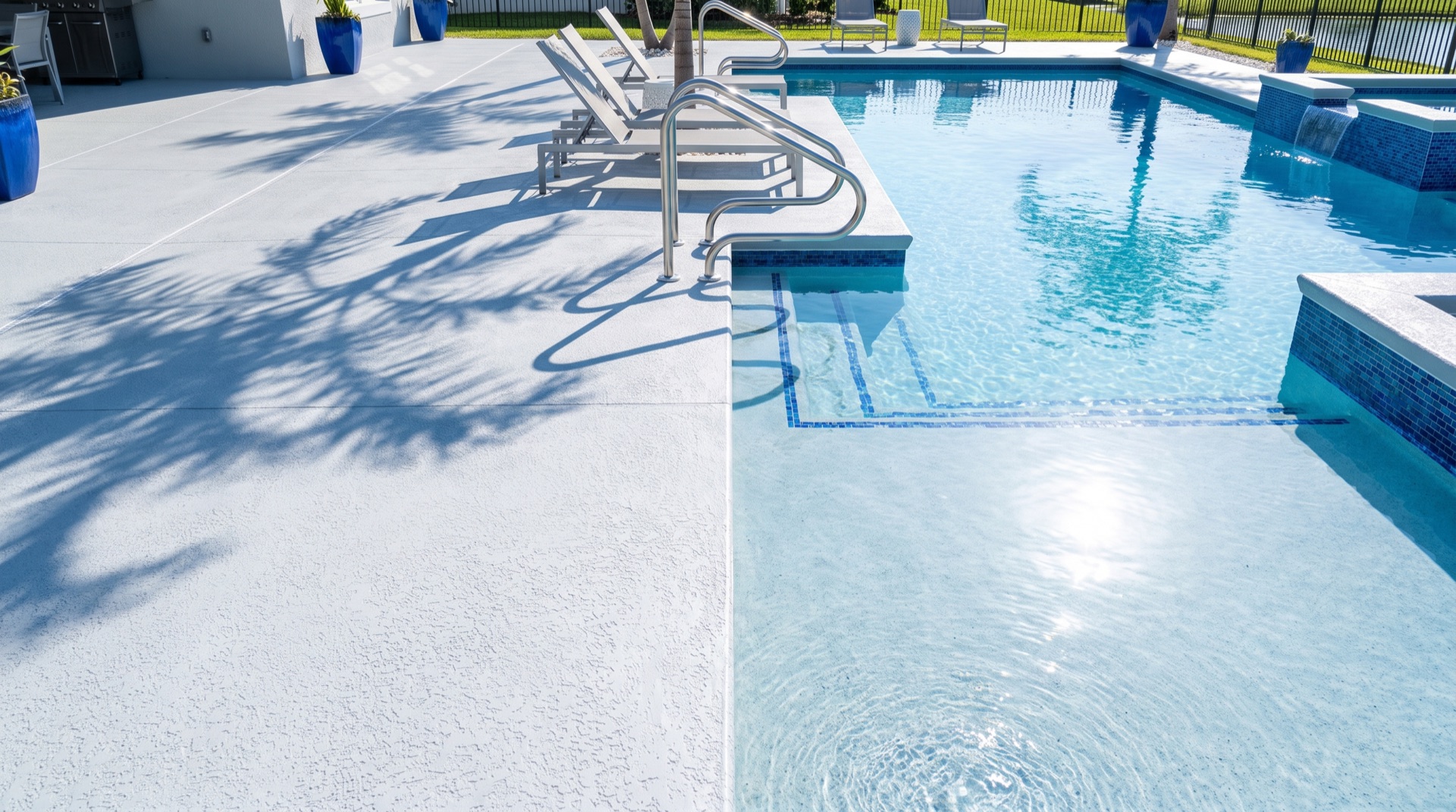
- Textured pool deck coating. A multi-layer system bonded into ground concrete, with non-slip aggregate broadcast in and a UV-stable top coat. It's what most people picture when they search for textured pool deck painting.
When the deck underneath is failing — crumbling cool-deck texture, spalled edges, a coat that has to be stripped first — the job becomes pool deck resurfacing instead.
| Deck paint | Stain or sealer | Textured coating | |
|---|---|---|---|
| Typical cost | $100–$300 DIY | About $1–$3/sq ft pro sealing | $5–$9/sq ft installed |
| Life by a Florida pool | 1–3 years | Reseal every few years | 10+ years |
| Wet-foot grip | Slick unless gritted; grit wears off | Stain adds none; gloss sealer can reduce it | Built into the finish |
| Hides cracks & stains | Briefly | No | Yes |
| Can it peel? | Yes — the usual failure | Stain no; sealer can wear or flake | Not when the slab is ground and tested |
When pool deck paint is genuinely fine
Paint isn't a scam — it's just a short-term product. It's the right call when you're listing the house soon and need the deck presentable, when the budget truly is a few hundred dollars this year, or when you're planning bigger repairs later and only want a season of looking cared-for.
Go in with the right expectations: use a product made for pool decks, mix in anti-slip additive, and don't put it over anything that's already peeling. Cost guides are blunt on that last point — paint applied over an existing coating or sealer that wasn't removed tends to crack and flake off early.
Why pool deck paint peels in Jacksonville
A pool deck is the hardest place in the yard for a thin film. Four things work against paint at once:
- UV. Open decks take direct sun most of the year. Acrylic film chalks and fades first, then loses its grip on the concrete.
- Wet-dry cycling. Splash-out, rain and afternoon storms soak the deck, then the sun dries it — every day. A surface-only bond can't take that for long.
- Pool chemistry. Chlorinated and salt water splash onto the same strip of deck along the coping, which is why paint almost always lets go there first.
- Moisture from below. Slabs poured on grade hold moisture. Without grinding and a moisture check, it pushes up under the film and lifts it (more on why coatings peel in Florida).
None of that is a defect in the paint can. It's the environment — and it's the reason a pool deck coating starts with a grinder instead of a roller.
Textured & cool-deck looksWant that knockdown, cool-to-the-touch texture you see on older Florida decks? A textured polyaspartic coating gives the same cool, grippy surface in lighter, heat-reflective colors — without the porous texture that grabs sunscreen and rust stains. How non-slip textures are graded →
What a textured pool deck coating includes
- Clean & grind. The deck is pressure-cleaned and mechanically ground so the coating keys into sound concrete. Loose old paint and sealer come off here.
- Crack repair. Hairline and spider cracks are filled and feathered so they don't telegraph through.
- Colored base coat. A tinted base sets the color — usually a light, cool-touch grey, sand or stone tone.
- Non-slip broadcast. Aggregate goes into the wet base, a little coarser on the wet apron and steps, finer where people lounge.
- UV-stable top coat. A polyaspartic seal that won't yellow and that hoses clean (why not plain epoxy outdoors).
Paint, coat or resurface? How to tell what your deck needs
Paint or stain if the concrete is sound, you're keeping costs to a minimum, and a one-to-three-year refresh fits your plans. Clean and seal if the deck looks fine and you mainly want stain protection. Coat it if the deck is structurally fine but faded, stained or hairline-cracked and you want grip, a cooler surface and a finish that lasts. Resurface it if old cool deck is crumbling, the edges are spalling, or a failed coating has to be stripped first — see pool deck resurfacing.
Not sure which bucket you're in? A free walkthrough answers it in a few minutes, and the pool deck paint vs. coating guide walks through the ten-year math. Current per-surface ranges are on the cost guide.