
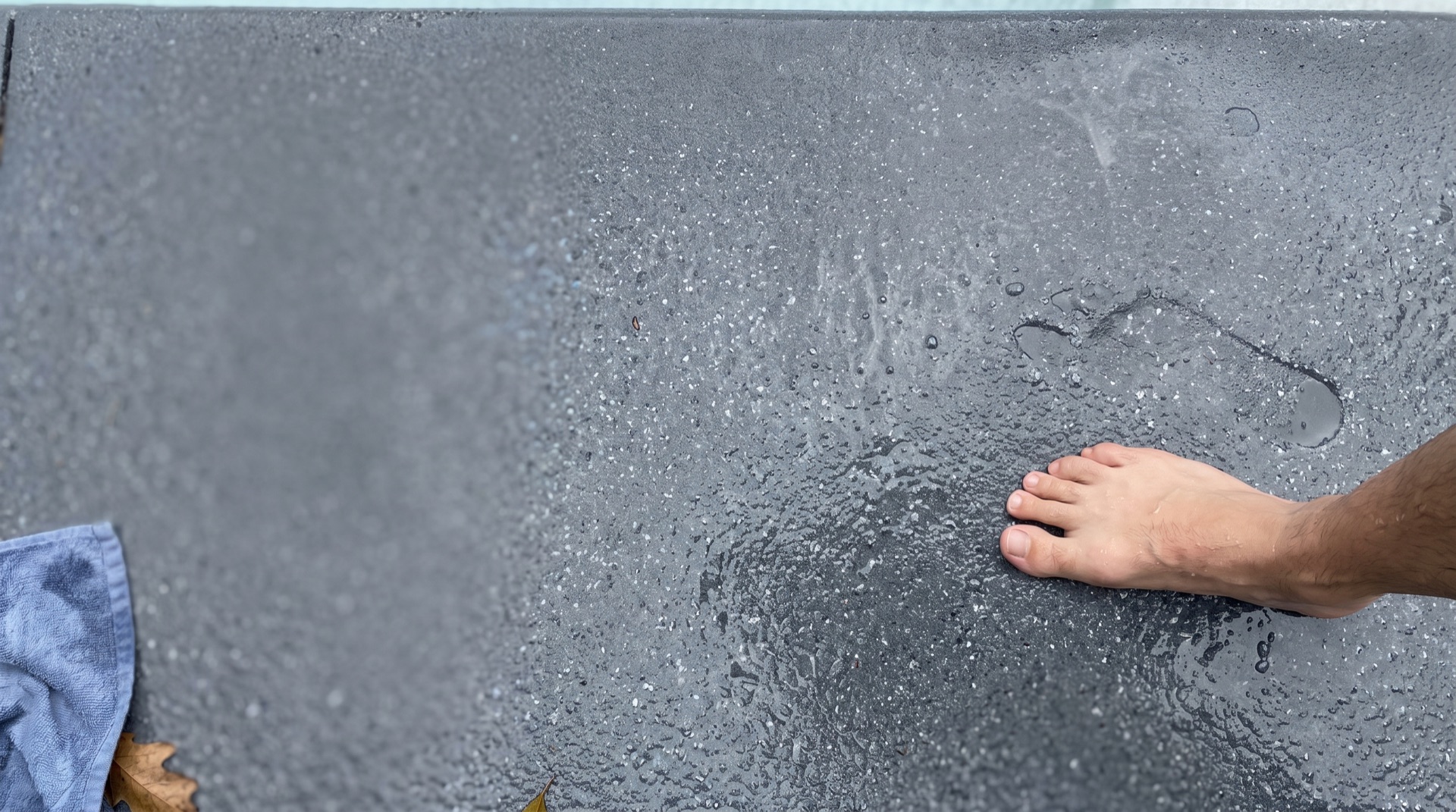
The slippery slab problem
Concrete in Northeast Florida doesn't stay grippy on its own. Afternoon storms leave standing water on flat slabs. Shade and humidity grow a thin algae film on north-facing walkways and lanais that's almost invisible until someone's foot goes out from under them. Pool water carries sunscreen and body oil onto the coping and the first few feet of deck. And a smooth, hard-trowelled slab — the kind builders pour on entryways and garage aprons — has almost no wet traction to begin with.
The instinct is to seal it. That's usually the wrong move, and it's the single most common mistake we're called out to undo. A film-forming sealer fills the surface porosity that was providing what little grip the concrete had, and a sealed smooth slab is often more dangerous wet than it was bare. Slip resistance has to be built into the finish, not applied over the problem.
Broadcast, not sprinkledThere are three ways to make a floor grippy, and only one of them lasts. Additive stirred into the topcoat settles unevenly and gets polished off. Grit sprinkled onto a cured surface has nothing holding it and sheds within a season. Aggregate broadcast into the wet base coat and sealed under a clear topcoat is mechanically locked in — the traction is structural, not topical.
How the texture is graded
“Non-slip” isn't one setting. The aggregate grade is the variable, and getting it wrong in either direction causes real problems. Too fine and the surface is still slick under a wet foot. Too coarse and it shreds bare skin, traps dirt in the profile, and makes the floor unpleasant to walk on or clean.
So the broadcast gets matched to how the surface is actually used — and often varies within a single job. On a pool deck, the wet apron around the coping and the steps take a slightly more aggressive grade than the lounging area where people sit, kneel, and put towels down. On a commercial floor, the washdown bay and the door threshold get more texture than the middle of a dry showroom.
- Fine broadcast — pool decks, lanais, patios, anywhere bare feet spend time. Grippy wet, comfortable to sit and kneel on.
- Medium broadcast — walkways, entryways, garage aprons, steps. Built for shoes and the occasional wet arrival.
- Coarse broadcast — ramps, loading areas, washdown bays, commercial wet zones. Maximum traction; not a barefoot surface.
Slip-resistant pool deck coatings
Pool decks are where slip resistance matters most and where the fine-grade broadcast earns its keep — permanently wet edges, bare feet, kids running, and a hard surface to land on. If a pool deck is the actual job you're pricing, that's its own page: cool-touch systems, crack and spall repair, cost per square foot, and what to do about failing cool deck or spray deck texture.
The short version: the traction comes from the same broadcast described above, kept fine enough to be comfortable barefoot, and sealed under a UV-stable polyaspartic so it doesn't chalk or yellow in the sun. See pool deck coating & resurfacing →
Where else non-slip matters
- Lanais & screened porches. Shaded, humid, and prone to algae film — the classic Florida slip hazard. See patio & lanai coating.
- Entryways & walkways. Smooth builder-poured concrete plus a rainstorm is the worst combination on any property.
- Steps & ramps. The highest-consequence surfaces on a job. Always get a more aggressive grade than the flat run they connect.
- Garage aprons. The transition strip stays wet longest and is walked on in flip-flops. See garage floor coating.
- Commercial & wet work areas. Kitchens, washdown bays, loading zones and shop floors, where a slip is a liability event. See commercial & industrial floor coating.
Prep still decides everythingA non-slip finish on a badly prepped slab fails exactly like any other coating — it just takes the traction with it when it goes. The slab still gets diamond-ground and moisture-tested first, which is why coatings peel in Florida when that step gets skipped. Grinding vs. acid etching →