
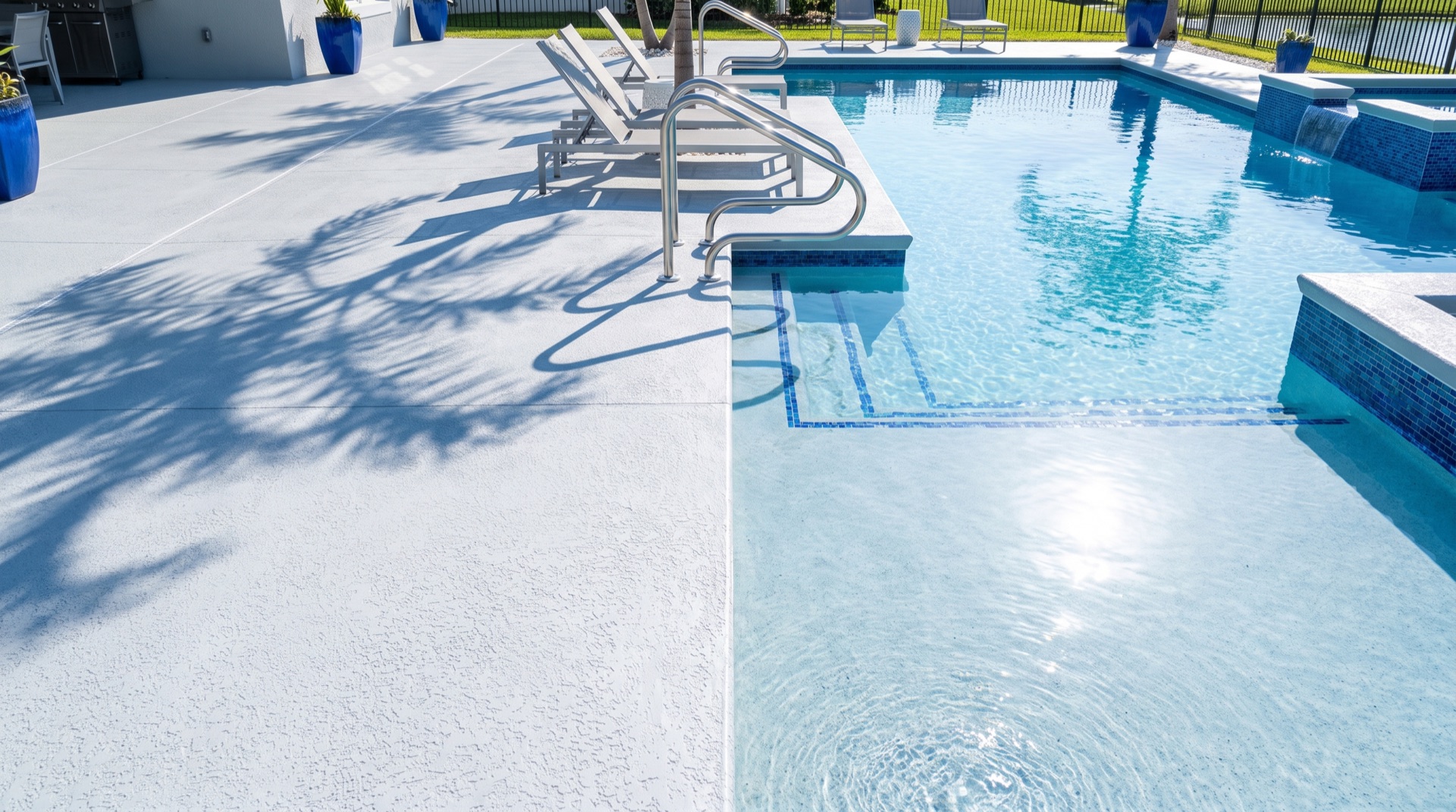
A pool deck that's cool underfoot and safe when wet
A Florida pool deck lives a hard life: standing water, chlorine and salt, sunscreen, and relentless UV that bakes it eight months a year. Bare or old concrete gets hot enough to hurt bare feet, grows slick where it stays wet, and spider-cracks as the slab moves. Resurfacing lays a new, engineered wearing surface right over the existing deck — no demolition, no repour, and nothing like the deck paint that peels every couple of years.
The two things that matter most on a pool deck are heat and grip. We install cool-touch, light-toned systems that reflect heat instead of storing it, with a non-slip aggregate broadcast into the coating so it stays safe for wet feet without feeling like sandpaper. Around a pool, prep matters even more than in a garage — standing water finds every shortcut, which is why coatings peel in Florida when the slab isn't ground and moisture-tested first.
Resurfacing vs. painting: why the deck needs more than a fresh coat
Almost every homeowner who calls us starts the same way: I need my pool deck painted. It's the natural way to describe it, and Jacksonville pool deck painters get searched for far more often than anything with the word “polyaspartic” in it. But the word hides an important difference, and it's the difference between a deck that lasts two years and one that lasts fifteen.
Pool deck paint is a thin acrylic film. It's rolled onto the surface, it sits on top of the concrete, and it's bonded by nothing more than surface tension and hope. In Florida sun and pool chemistry, that film chalks, fades, and starts lifting at the edges — usually inside two or three seasons. Then it has to come off before anything else can go down, which is its own job.
A pool deck coating is a system, not a film. The slab is ground open so the coating keys mechanically into the concrete, cracks and spalls are repaired, a pigmented base goes down, non-slip aggregate is broadcast into it while it's wet, and a UV-stable polyaspartic seal locks the whole thing together. It's thicker, it's bonded, and it's built for the specific abuse a Florida deck takes.
So when someone asks for pool deck painting, we quote the coating — because it delivers the result they're actually describing: a clean, uniform, comfortable deck that still looks right in five years. The full paint-vs-coating comparison is here → If your deck is still sound and you're weighing paint, stain, or a textured coating, start with pool deck painting & coating.
Why coating, not epoxy aloneAn open pool deck is the worst place for traditional epoxy — it yellows and chalks under UV within a season or two. The right pool-deck system is a UV-stable polyaspartic or polyurea finish built for direct sun. Here's the full polyaspartic-vs-epoxy breakdown →
Cool deck, spray deck & textured finishes
If your deck was built before roughly 2010, there's a good chance it wears a sprayed acrylic-cement texture — sold as cool deck (often written Kool Deck, after the original product), spray deck, or knockdown texture. These finishes were genuinely good at one thing: staying cool. They're much less good at everything else.
Sprayed texture is porous, so it grabs sunscreen, leaf tannin, and rust from patio furniture and won't give it back. The raised peaks wear down under traffic, the edges near the coping crumble first, and once it starts shedding there's no patching it invisibly. Most of the tired, blotchy decks we're called out to look at are failing spray deck, not failing concrete.
A modern textured polyaspartic finish gives you the same two things you liked about cool deck — a cool surface and real grip — without the porosity. It cleans with a hose instead of a scrub brush, it doesn't chalk, and the texture is engineered rather than sprayed by feel. When the old spray deck is delaminating, the loose material is removed and the slab is ground back to sound concrete before the new system goes down. When it's still tight, it can often be profiled and coated over directly.
Non-slip texture, tuned for bare feet
Slip resistance around a pool isn't a nice-to-have, and it's the thing people get wrong most often. A clear sealer over smooth concrete can make a wet deck more dangerous, not less — it fills the surface porosity that was providing what little grip there was.
Real traction comes from aggregate broadcast into the coating while it's still wet, so the texture is part of the system rather than a topical additive that wears off. The grade matters: too fine and it's slick when wet, too coarse and it shreds bare feet and traps dirt. We tune the broadcast to the surface — a little more aggressive on the wet apron immediately around the coping and the steps, slightly finer out on the lounging area where people sit and lie down.
The result is a deck that's grippy under a wet foot and still comfortable to walk on barefoot, kneel on, or set a towel down on. It's the same slip-resistant approach we use on lanais and driveways, dialed in for skin instead of shoes and tires. More on how non-slip coatings are graded →
What a pool deck resurfacing job includes
- Strip what's failing. Old deck paint, delaminating spray deck, and loose cool-deck texture come off first — a new system is only as sound as what's under it.
- Clean & profile. The deck is pressure-cleaned and mechanically ground so the new coating keys into sound concrete instead of sitting on it.
- Crack & spall repair. Cracks, pop-outs, and spalled edges near the coping are patched and feathered flush.
- Base coat. A tinted polyurea or polymer base is applied as the color and body of the system.
- Non-slip broadcast. Aggregate is broadcast into the wet base for wet-deck traction, graded finer or more aggressive depending on the zone.
- UV-stable seal. A polyaspartic clear coat locks it in — cool-touch, stain-resistant, and color-fast in the sun.
Finishes for a Florida deck
Popular pool-deck looks include natural stone and travertine-style textures, flagstone patterns, and clean solid-color or subtle flake finishes in coastal greys and sandy tones. Lighter colors read best around a pool — they stay cooler and make the water pop. If your lanai and deck connect, we can carry the same finish across both so it reads as one outdoor space. See patio & lanai coating.
New pool in Nocatee, RiverTown or Ponte Vedra?If your builder poured a plain broom-finish deck, resurfacing is the fastest way to turn it into a finished, resort-style surface — before the concrete has years of sunscreen and chlorine worked into it.