
One chemistry family, two jobs
Coating websites throw "polyurea" and "polyaspartic" around like competing products, which is why the confusion exists. Chemically, they're family: polyurea is the broad category — a resin that cures by reacting an isocyanate with an amine — and polyaspartic is a specific type of polyurea (an aliphatic polyurea ester) engineered for two things pure polyurea is bad at: a slower, workable pot life and top-tier UV stability. So the comparison isn't "which one is better." It's "which version belongs in which layer."
Polyurea — the base coat
Straight polyurea cures fast — in some formulations, minutes. That speed makes it a poor finish coat (there's barely time to work it) but a superb base coat: it wets deep into freshly diamond-ground concrete, bonds harder than the slab itself, and stays slightly flexible, so it moves with the concrete through Florida's heat-swell cycles instead of cracking off it. It's also far more tolerant of humidity during install than epoxy — no small thing in Jacksonville, where the air is wet eight months a year.
Polyaspartic — the top coat
Polyaspartic keeps the polyurea toughness but slows the cure to a workable window, which lets an installer flood it evenly over a flake broadcast and back-roll it glass-smooth. And because it's aliphatic, it doesn't yellow in sunlight — the failure that kills standard epoxy on any floor that sees sun through an open garage door, a pool deck, or a lanai. It's also highly abrasion- and chemical-resistant, which is exactly what you want in the layer that takes tires, tools, and cleaning.
| Polyurea (base) | Polyaspartic (top) | |
|---|---|---|
| Role in the system | Primer/base — the bond | Wear layer — the finish |
| Cure speed | Very fast | Fast, but workable |
| UV stability | Varies by formulation | Excellent — won't yellow |
| Flexibility | High — moves with the slab | Moderate |
| Humidity tolerance | High | High |
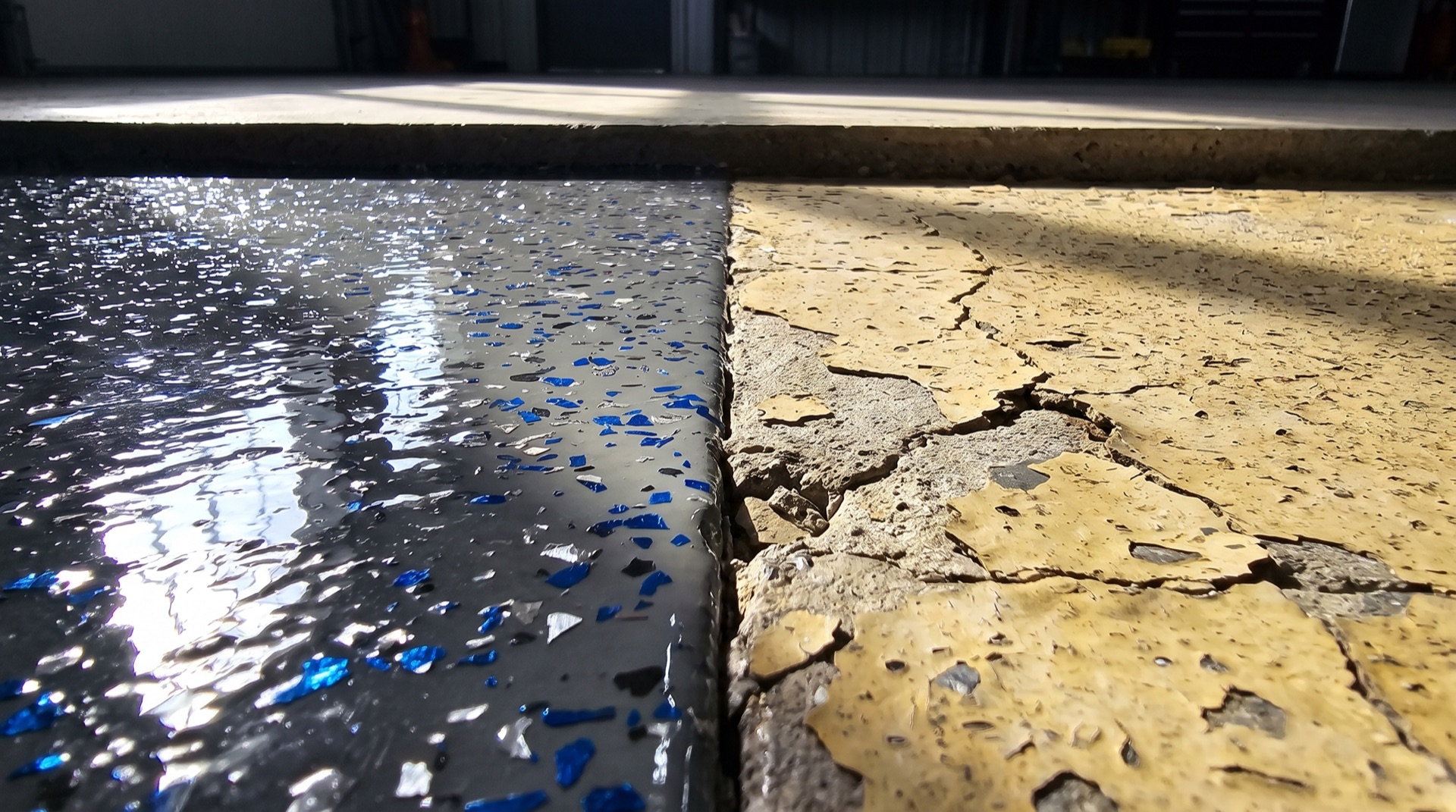
The Florida systemThis is why our standard install is a polyurea base + flake broadcast + polyaspartic top coat, all in one day. The polyurea does the bonding, the polyaspartic does the surviving. One resin doing both jobs is a compromise; two doing their own job is a 15–20 year floor installed before dinner.
Where epoxy fits in all this
Epoxy is a different chemistry entirely — slower-curing, rigid, and not UV-stable unless top-coated. It still has a place indoors (and it's the affordable base layer in some interior systems), but in direct Florida sun or on a slab with any moisture, it's the resin most likely to yellow, bubble, or peel. The full breakdown is in our polyaspartic vs. epoxy comparison.
What to ask an installer
If a quote just says "epoxy" or "polyurea coating," ask what's actually in each layer: what's the base, what's the top coat, and is the top coat aliphatic (UV-stable)? And ask how the slab gets prepped — because no resin, however good, survives skipped grinding. Those two questions separate a $2,000–$4,250 floor that lasts two decades from one you'll redo in two summers.