
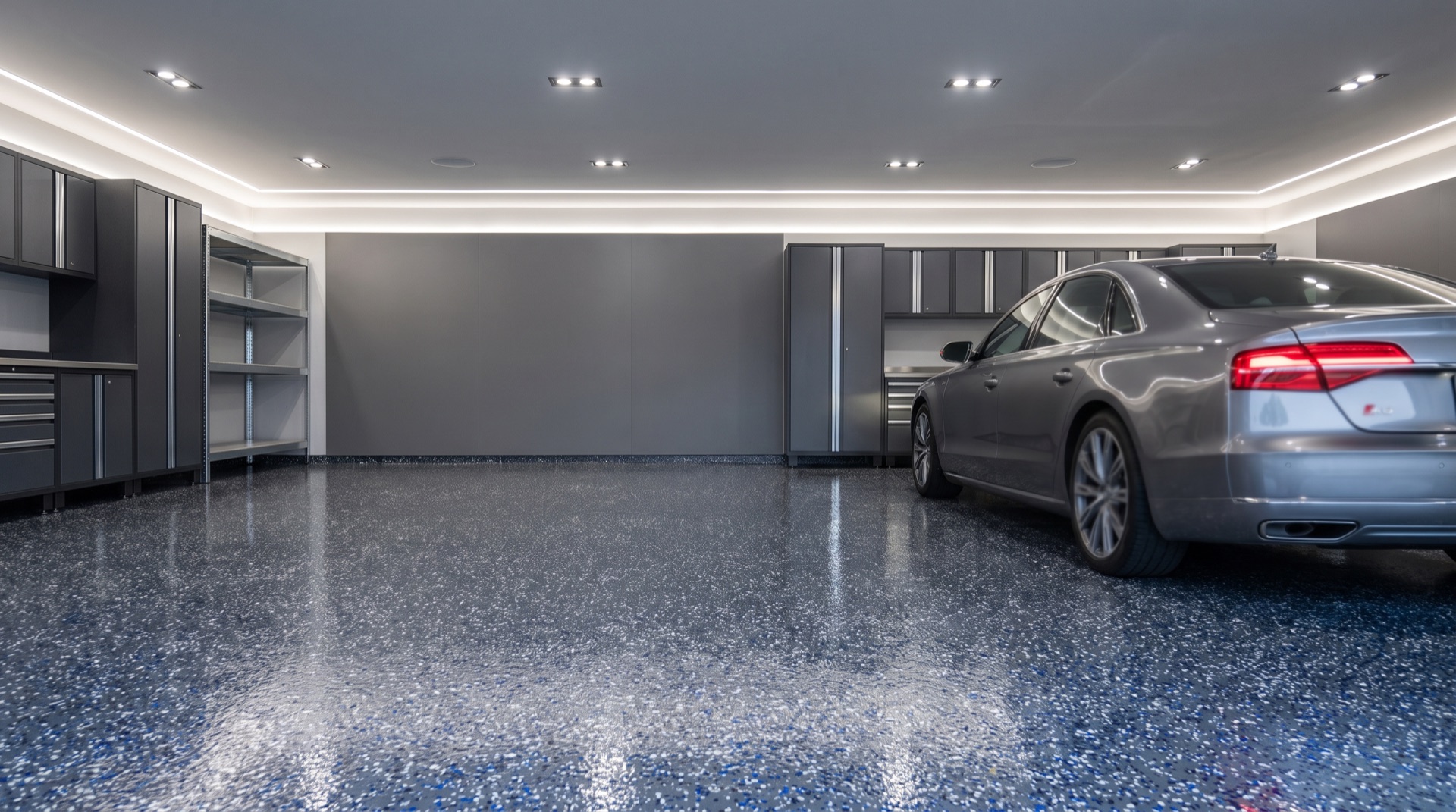
You can't coat over a failing floor
A new coating is only as attached as whatever it's sitting on. Roll a fresh layer over old epoxy that's already lifting and you've built a beautiful floor on a peeling foundation — it comes up in sheets, usually within the first hot-tire summer. This is the most common mistake we see on Jacksonville re-do jobs: the second coating failed because the first one was never removed. Before anything new goes down, the slab has to be taken back to bare, profiled concrete. Here's how that actually happens.
Option 1: Diamond grinding — how the pros do it
A walk-behind grinder with diamond tooling (backed by a dust-containment vacuum) strips the old coating and profiles the slab in the same pass. On a typical 2-car garage it's a few hours of machine work, and it solves the whole problem at once: coating gone, surface opened, slab ready to re-coat the same day. It's the only method that leaves the floor in coating-ready condition — which is why on a professional re-coat, removal isn't a separate project. It's just the prep step.
Option 2: Chemical strippers — slow, messy, incomplete
Stripping products soften epoxy so it can be scraped up. The catch: the aggressive strippers that worked fast are heavily restricted now, and the consumer-safe ones need long dwell times, plastic sheeting, and usually two or three rounds. Well-bonded areas — ironically, the parts of your floor that didn't fail — resist stripper the hardest. You end up scraping sludge for a weekend, disposing of it properly, and the slab still needs grinding before any coating will bond. As a route to a new floor, it's all pain, no shortcut.
Option 3: Scraping and sanding — for flakes, not floors
A floor scraper takes off the loose, already-peeling sections easily — that part feels productive. But an orbital sander gums up on epoxy, a rental grinder without the right diamonds skates over it, and what's left is a patchwork of bare spots and stuck coating that no product can go over evenly. Scraping is fine as cleanup for a failing floor you're about to have professionally ground; it's not a removal method on its own.
| Diamond grinding | Chemical stripper | Scrape / sand | |
|---|---|---|---|
| Time (2-car garage) | A few hours | 1–2 weekends | Days, incomplete |
| Gets well-bonded areas | Yes | Poorly | No |
| Slab ready to re-coat | Yes — same day | No — still needs grinding | No |
| Mess & disposal | Contained by vacuum | Chemical sludge | Dust & debris |
The good newsIf you're removing epoxy because you want a floor that works this time, you likely never need to touch it yourself: grinding off the old coating is part of standard prep on a re-coat. It's the same machine pass that profiles the slab. Heavy build-up or multiple old layers can add a line item — you'll see it itemized on the quote, never discovered on install day.
Why the old floor failed matters too
Removal is half the job; the other half is not repeating history. Most failed Jacksonville floors trace back to the same causes — acid-etch prep, slab moisture nobody tested for, or a bargain resin that couldn't take UV. A proper re-coat fixes all three: ground slab, moisture test, and a polyurea base with a UV-stable polyaspartic top coat. That's the difference between removing epoxy once and making it a recurring chore.
Common in the older neighborhoods
Re-do jobs cluster where garages have had a coating long enough for a cheap one to fail — Mandarin, Orange Park, Southside, and the established streets across the 904. If your floor is flaking, snap a few photos, note roughly when it was coated, and call — that's enough for a same-day itemized quote.